
Orlando has more kinds of property to watch than most cities
Orlando’s commercial property runs from downtown office towers with shared lobbies and parking garages, through the hotels, resorts and attraction-area retail along International Drive and US-192 toward Kissimmee, where activity does not stop at night, to the medical office buildings beside the hospitals and the newer ones in Lake Nona, the plazas along Colonial Drive, Semoran Boulevard and Orange Blossom Trail, and the communities whose pools, clubhouses and gates a homeowners’ association has to secure.
A camera system that fits one of those does not fit the next. The questions are the same everywhere: which doors people use, where money or stock changes hands, where the cars park, what the lighting does after dark, and what you would want to review after an incident. In Orlando the answers are shaped by shared buildings, long operating hours and a great deal of asphalt. Orlando adds a question the smaller towns rarely raise: which parts of the building are yours to put a camera on at all.
Multi-tenant buildings, garages and shared lots
In a downtown tower or a suburban office building the first question is who owns which view. The landlord’s cameras usually cover the lobby, the elevators, the loading dock and the garage levels; a tenant’s cameras cover the suite door, the reception desk and whatever inside the suite is worth watching. The two systems should not be one system, because the tenant should not be able to review the garage and the landlord should not be able to review the tenant’s office. In a tower the recorder for a suite goes inside the suite, its logins stay with the tenant, and anything on the exterior or in the garage is a request to the property manager before it is a drill hole.
The camera network in a tower often has to ride the building’s riser from the telecom room to the suite, the same path as the data cabling, and the recorder wants a wired connection in conditioned space rather than a shelf in a hot closet. We plan the camera runs and the structured cabling for the suite together, so the drops to the cameras land on the same labeled patch panel as the rest.
Hotels, resorts and the attraction corridor
A hotel has hundreds of doors and a lot of people who are supposed to be there, which changes what the cameras are for. The front desk, the back office and the cash drawers at the restaurant and bar need faces at identification grade. The pool deck, the corridors and the parking areas need wide coverage that shows where people went. The porte cochère is floodlit while the lot behind it is dark, so the cameras at the entrance need wide dynamic range or they show a white glare and a black lot in the same frame.
Hospitality sites also have more people who need to see the footage: a manager on each shift, the owner, sometimes the brand or the insurer. Each of them gets their own login, limited to the cameras they need, so access can be removed when a manager leaves. Retention is usually set by the insurer or the brand rather than by the recorder’s default, and the work is fitted around occupancy, which in a resort means a wing at a time.
Medical offices, retail plazas and gated communities
Orlando’s clinics are usually suites in a medical office building beside a hospital campus, so the lobby, the garage and the exterior are already on the landlord’s cameras and the practice only needs its own: the suite door, the waiting room, reception and the corridor to the rear exit, never the exam rooms. The recorder lives in the practice’s locked IT closet or in a hosted account, and the practice manager, not the building, holds the logins.
A plaza tenant on Colonial Drive or Semoran Boulevard shares a lot with a dozen other doors, so the useful exterior view is the sidewalk and the spaces in front of the suite, not the whole lot, which the landlord may already cover. Inside, the register, the front door and the back door are the three views that ever get reviewed; the rest is optional.
Gated communities and homeowners’ associations have a different problem: amenities that residents use at all hours and nobody staffs. The pool gate, the clubhouse doors and the mail kiosk are where the cameras go, and they work best paired with access control, so the record of whose fob opened the gate lines up with the video of who walked through it. An Orlando community pool gate fitted with a magnetic lock and a proximity reader is on our projects page.
One Orlando job: cameras where the cable could not go
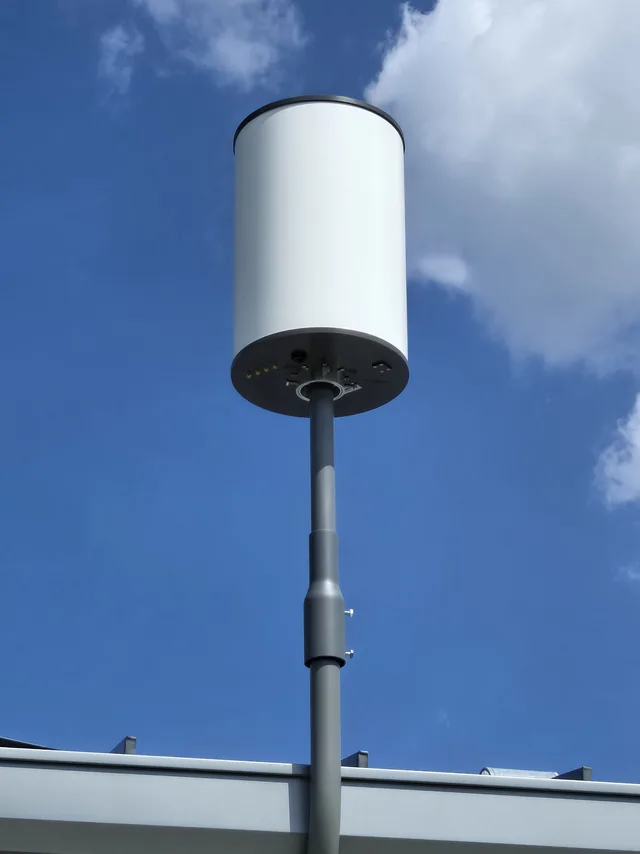
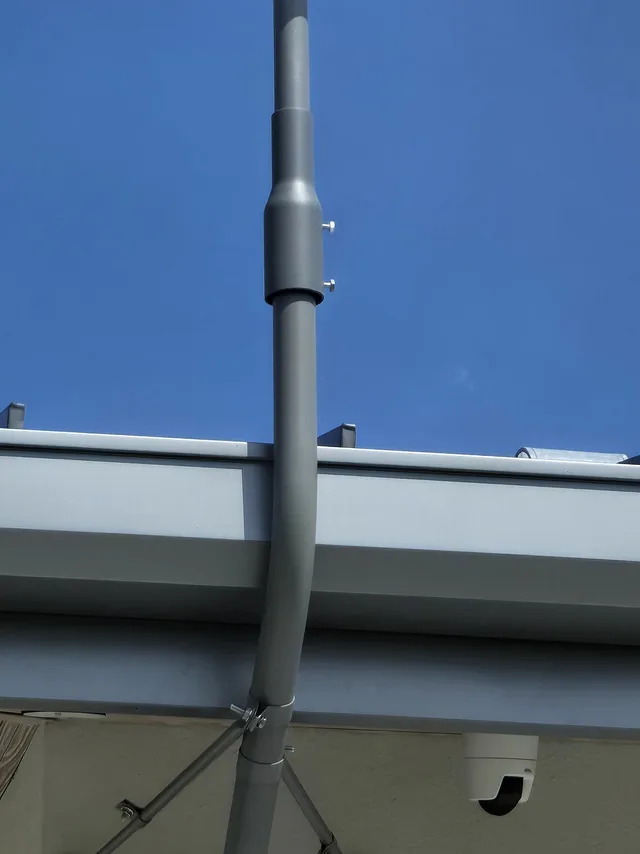
At a commercial building in east Orlando, two dome cameras sit under the eave beneath the mast of an outdoor wireless antenna, one end of the wireless bridge the site uses where no cable runs. The bridge was there first, from a visit in February 2025; the cameras went up under it in April.
That is the pattern for a lot of Orlando properties: an outbuilding, a far corner of a lot, a second building across a drive, all places where a trench is expensive or impossible and a wireless link built as part of the business WiFi does the job.
What an Orlando property adds to the camera plan
- Camera drops run through the building riser to a labeled patch panel in the suite, where the landlord controls the telecom room
- Garage and lot coverage from 360-degree or pan-tilt-zoom units, and a plate camera at a gate or garage entry
- Wireless bridges to an outbuilding, a gate or a far corner of the lot
- Per-manager logins for hospitality sites, removable the day a manager leaves
The full list of camera types, recording options and cabling is on our security cameras page.
Free on-site assessment
Tell us the building and how many tenants, floors or doors it has. We will walk it with the property manager’s rules in hand and come back with coverage for the parts of the building you actually control.
FL License #ES12001608
Common questions about security cameras in Orlando
Can one camera system cover a multi-tenant office building in Orlando?
It can, but it usually should not. In a building with several tenants the common areas, the garage and the exterior belong to the landlord, and a suite belongs to the tenant renting it. One recorder holding both sets of cameras means one set of administrators can see both, which neither side wants. The usual arrangement is a building system owned by the landlord or the property manager for the shared spaces, and a separate, smaller system per tenant for the suite, each with its own recorder and its own logins.
What the two systems can share is the pathway. Camera drops for a suite run back through the building’s riser the same way the data cabling does, and a tenant adding cameras to a suite that is already cabled often needs only a few extra drops and a small recorder. The property manager’s rules on mounting hardware outside the suite, on the exterior and in the garage still apply, and are settled first.
What does a hotel or resort camera system need that an office does not?
Scale, lighting and people. A hotel has far more doors and far more people who are allowed to be there, so the system is less about catching an intruder and more about being able to reconstruct what happened: who was at the desk when a dispute started, which way a guest went after an incident on the pool deck, which car left the lot. That means wide coverage of the public areas plus identification-grade cameras at the desk, the cash drawers and the entrances, and recorders with enough storage for the retention the insurer or the brand expects.
The lighting is harder than in an office. Entrances are floodlit all night while the lot and the service areas are dark, so cameras at the boundary between the two need wide dynamic range, and the night picture matters as much as the day one. More people also need access to the footage, so each manager gets a login limited to their cameras, and installs are scheduled around guests rather than around the installer.
Who powers and owns the far end of a wireless camera link?
The far end of a bridge is a small installation of its own, and it is the part Orlando property owners forget to plan. The remote antenna needs a weatherproof box beside it with a power supply and a small switch, and that box needs mains power from somewhere: an existing circuit in the outbuilding, a run from the gate operator, or a new circuit an electrician pulls. The cameras at that end draw their power from the switch over their own cable. Where the far end has no power at all, a solar kit is possible for one or two cameras, and a trench for power alone is still cheaper than a trench for power and data.
Ownership follows the building line. On a single-owner site the whole link is yours. In a multi-tenant property or a community with an association, the pole, the eave and the gate may belong to the landlord or the association, and the agreement to mount on them, to draw power there and to leave the box in place when a tenant moves out is settled in writing before the first bracket goes up. The link itself needs a clear line of sight between the two antennas, so a new sign, a grown tree or a parked trailer in the wrong place is a maintenance call rather than a mystery.
Orlando and the metro around it
Camera work in Orlando runs from downtown and the International Drive corridor out to the suburbs: Windermere and Winter Garden to the west, Kissimmee and Four Corners to the south, Clermont beyond them. There is no showroom; the crew comes to the building. Orlando also has pages for structured cabling and IT support, and two of the towns around it each have a page for one service: security cameras in Clermont and business phone systems in Winter Garden. See the full service area
Get started today. Take the Technical Out of Technology.
Tell us the building, who owns which part of it, and what happened that made you call. We will walk it and quote the cameras your side of the line needs.