
Cameras for the property Tampa Bay has
Tampa’s commercial property is shaped by two interstates and a bay. Interstate 4 brings the distribution and warehouse buildings in from the east, Interstate 75 runs them north and south through Hillsborough County, and between them sit the offices, clinics and multi-tenant buildings of the city itself, the retail and restaurants that serve it, and the churches and schools that need coverage without visible cable. North of the city, up the Suncoast Parkway and US 19 into Hernando County, the buildings are newer: commercial shells, and the clubhouses, pool buildings and gatehouses of communities still being built around Brooksville and Spring Hill.
A camera plan for a Tampa property starts from its own geography: the dock wall and the yard gate of a distribution building, the register and the back door of a storefront, the lot a clinic’s staff cross after dark, the amenity buildings of a community that nobody staffs, and in every case what the lighting does at night and what you would want to review after an incident. On the Gulf side the answers are shaped by long buildings, big yards, afternoon weather and salt air. That is how we approach every security camera job, and this page is about what it looks like here.
Warehouses and yards along I-4 and I-75
A distribution building is the camera job where distance decides the design. A single network cable run tops out around 328 feet, and a dock wall, a yard gate and a far corner of the lot are routinely further than that from wherever the recorder sits, so the plan needs fiber to a switch at the far end, a wireless bridge to a pole, or a camera network laid out in segments from the start. The cameras themselves go over the dock doors, along the yard fence, at the gate, and inside over the pick lanes and the shipping desk, where a dispute about what left on which truck is settled by footage rather than argument.
The yard wants a pan-tilt-zoom or 360-degree camera on a corner of the building rather than a row of fixed ones, and the gate wants a camera dedicated to plates, with a shutter fast enough to freeze a truck turning in. The recorder wants conditioned space and a wired connection. In a building where the telecom room is a plywood board in a corner, that often means building it a rack first, which is work we do ourselves on the same visit.
Storefronts, clinics and the new buildings up the Suncoast Parkway
For a shop or a restaurant the views are predictable: the register and the front door, the back door and receiving, and the parking spaces nearest the entrance. The cameras share a network with the point-of-sale only if that network is segmented, and the guest WiFi stays off both. A clinic or dental practice wants the door, the waiting room, the reception desk and the lot where staff walk to their cars after dark, and no cameras in exam rooms. Recording stays on a recorder in a locked room or goes to a hosted system, with remote viewing limited to the people who should have it.
In Hernando County a good share of the work is new construction, which changes when the cameras are planned. The rough-in goes in before drywall and the trim-out after, and the amenity buildings of a new community, the gatehouse, the pool building, the clubhouse, are where the cameras go, because residents use them at all hours and nobody staffs them. They work best paired with access control, so the record of whose fob opened the gate lines up with the video of who walked through it, and both are designed before the walls close.
Weather on the Gulf side
Florida’s west coast gets some of the most lightning in the country, the summer rain arrives most afternoons, and anywhere near the bay the air carries salt. Outdoor cameras here need an IP66 or better weather rating, housings and mounting hardware that will not corrode in a few seasons, a drip loop at every camera so water runs off the cable rather than into the connector, and outdoor-rated cable from end to end.
Lightning is the part that takes out recorders. The surge protection and grounding that prevent it, and the night-picture choices at a floodlit entrance, are covered in the questions on our security cameras page. Here they are not optional: the afternoon storms arrive on a schedule for half the year, and the exterior cameras live in them.
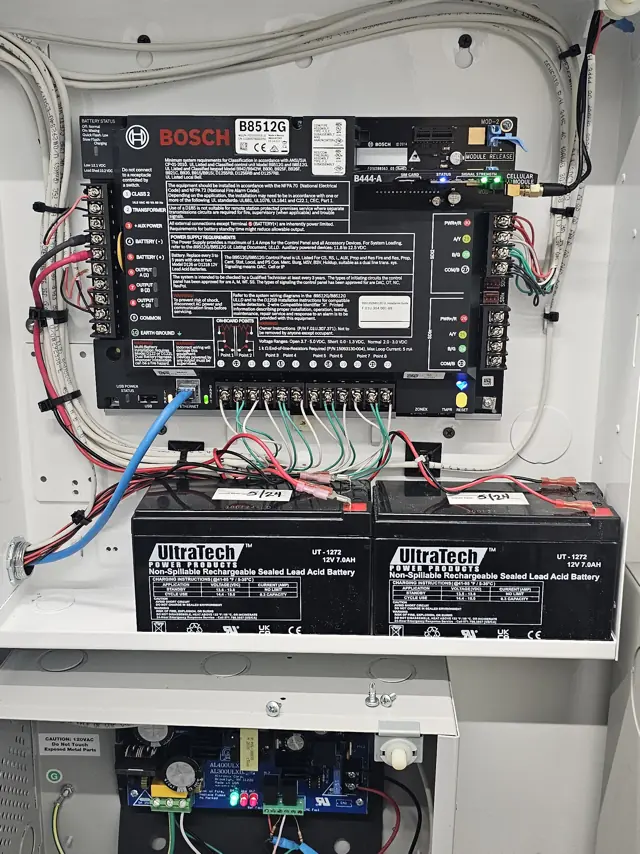
The Tampa photo on this page is an alarm panel, not a camera
We have not yet published a camera job from Tampa, and this page does not pretend to one. The Tampa job in the photo at the top of this page is intrusion alarm work: at a commercial building in Tampa in July 2024 our crew installed the Bosch B8512G alarm control panel shown, with its cellular communicator, terminated wiring and battery backup. The camera jobs with photos are in Orlando and Clermont, and the panel itself is on the projects page.
It belongs on a camera page for a practical reason. An intrusion panel and a camera system at the same property usually share a telecom room and the same low-voltage cable plant, and an alarm event on the panel is the moment you most want footage of. The same licensed crew installs both, so a Tampa property that wants cameras and an alarm gets one design rather than two contractors retrofitted to each other.
System options for a Tampa property
- IP camera systems powered over the network cable, and HD-over-coax upgrades that keep sound existing coax and replace only the cameras and the recorder
- Fiber or a wireless bridge to the far end of a yard, a gate or a second building, where a copper run cannot reach
- 360-degree and pan-tilt-zoom cameras for yards, lots and open floors; fixed cameras at face height for doors and registers
- A camera dedicated to plates at a gate or a yard entrance
- On-site recording or a hosted system, sized for the retention your insurer, your lease or your franchise expects
- Remote viewing from a phone or desktop, one login per person, removable the day they leave
- Surge protection and weather-rated hardware for the Gulf side, and cabling run by the same crew that mounts the cameras
Free on-site assessment, drive in the quote
Call and describe the property. We walk it before we quote it, look at the doors, the dock, the lot and the lighting after dark, and come back with the coverage it needs rather than the largest system that fits. The drive from Central Florida is in the quote, not added afterwards.
FL License #ES12001608
Common questions about security cameras in Tampa
Do you install security cameras in Tampa, or only around Orlando?
Both. SPCom Solutions is a service-area business based in Central Florida, and Tampa, the rest of Tampa Bay and Hernando County are the Gulf end of the territory we work. The Tampa Bay and Hernando County listing on Google is ours, and the profile has no address because there is no office there: the crew comes to your building.
The distance is planned rather than ignored. A site visit comes before any quote beyond a small service call, the installation is scheduled as full days on site with everything for that phase on the truck, and the drive is built into the number. If a job is too small or too far for us to service well, including the follow-up visit a year later, we say so when you call.
Is CCTV the same thing as a security camera system?
In everyday use, yes. CCTV, closed-circuit television, originally meant analog cameras wired over coaxial cable to a monitor and a recorder in the same building, a circuit closed to the outside world. Most of what is installed today is an IP camera system instead: the camera digitizes the video itself, sends it over standard network cable to a network video recorder, and usually draws its power from the same cable. People still search for CCTV installation and mean the whole category, and we install both kinds.
Where the term still matters is an older Tampa building with coax already in the walls. Modern HD-over-coax cameras deliver 1080p and higher pictures over that cable, so an upgrade often keeps the runs and replaces only the cameras and the recorder, and coax can go farther than a single network run, which needs a switch or fiber beyond about 328 feet. For a new installation, IP is the better choice: higher resolution, detection on the camera, and an easier path to adding cameras later.
What does a warehouse camera system in Tampa need that a storefront does not?
Reach, mostly. A storefront’s cameras are within a short cable run of the recorder and cover a handful of fixed views: the register, the doors, the front parking. A distribution building has a dock wall, a yard, a gate and interior lanes that are hundreds of feet apart, so the design starts with how the video gets back: fiber to a switch at the far end, a wireless bridge to a pole in the yard, or the camera network built in segments. The counts are higher, the cameras over the yard and the gate are different animals from a lobby dome, and the recorder needs the storage to keep weeks of footage from all of them.
The lighting and the weather are harder too. A yard is dark while the dock is lit, the gate camera has to read a plate on a truck that is moving, and every exterior camera is in the rain and the lightning for its whole life. None of that is exotic, but it is the reason a warehouse system is designed from a walk of the site rather than a count of doors.
Tampa, Hernando County and the rest of the service area
SPCom Solutions is a service-area business: the crew comes to your building, and there is no showroom to visit. Tampa, Brooksville and Spring Hill are covered from our Central Florida base, with the drive planned into each job; the Tampa Bay and Hernando County page describes how. Tampa also has a page for IT support. Back along I-4, Orlando has pages for security cameras, structured cabling and IT support, and security cameras in Clermont covers the plazas along US-27 and SR-50. See the full service area
Get started today. Take the Technical Out of Technology.
Tell us what the property is, how many doors and how much yard it has, and what has worried you. We will walk it and come back with a camera plan and a quote that already includes the drive.