
Fire alarm systems across Central Florida
A fire alarm system is not a product you pick off a shelf. It is designed around the building — its occupancy, its layout, and the code requirements that apply to it — and then installed, tested and kept in service for as long as the building is occupied. We handle all three stages for commercial properties across Central Florida and the surrounding area.
Because we also install the structured cabling, security cameras and access control in the same buildings, the fire alarm system goes in as part of one coordinated low-voltage plan rather than as a separate trade working around everyone else.
What a commercial fire alarm project involves
- System design – device placement and coverage worked out from the building's occupancy and floor plan
- Installation – control panel, initiating devices and notification appliances, wired on dedicated runs
- Integration – tied into access control so doors release correctly on an alarm
- Ongoing service – testing, maintenance and repair after the system is live
Free site visit & walkthrough
Fire alarm work starts with the building, not a brochure. Call to schedule a free on-site visit — we will look at the space, the occupancy and any existing system, and come back with a plan you can build to.
FL Certified Alarm System Contractor I #EF20001125, held by our qualifying agent (verify at Florida DBPR)
One contractor for the whole building
Most buildings end up with a fire alarm company, a camera company, a cabling company and an IT provider — four numbers, and four people pointing at each other when something stops working. We do all of it, so the panel we install and the IT support team that keeps the network up answer to the same phone number.
Common questions about commercial fire alarm systems
What does a commercial fire alarm system consist of?
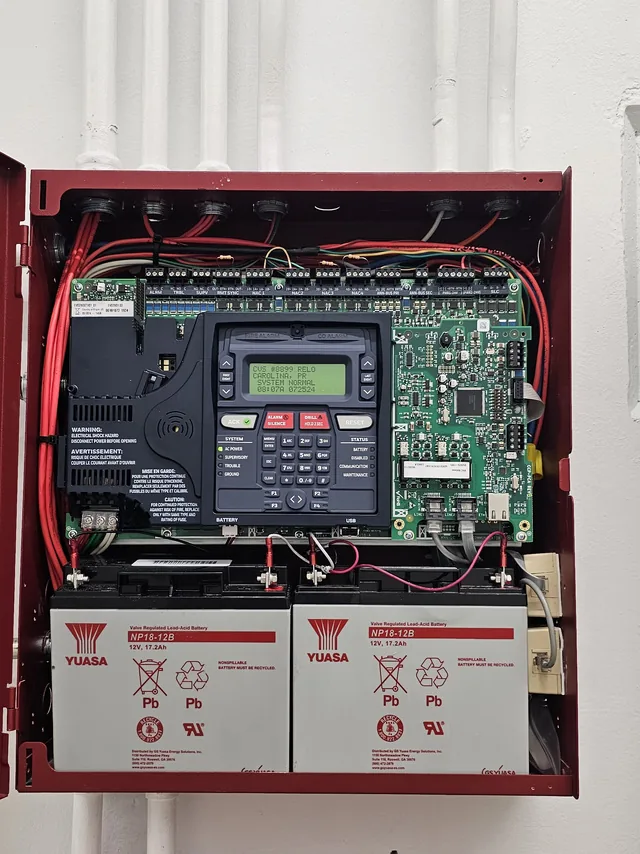
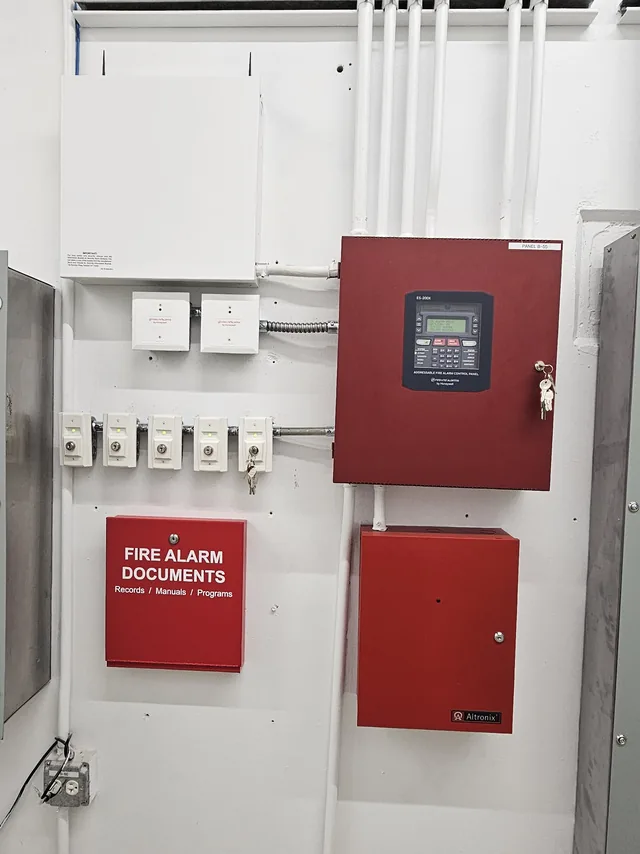
A commercial fire alarm system has three main parts: a control panel, initiating devices and notification appliances. The control panel is the brain. It powers the circuits, monitors every device connected to it, and decides what happens when one of them activates. Initiating devices are what detect a fire or let a person report one: smoke detectors, heat detectors, manual pull stations near the exits, and switches that watch a sprinkler system for water flow. Notification appliances are what tell the occupants to leave: horns, strobes, speakers and combination units, mounted where people can hear and see them.
Around those three parts sit the pieces you rarely notice, such as dedicated wiring on its own runs, backup batteries so the system stays up when the building power does not, and a communicator that reports an alarm to a monitoring center. Every part has to be compatible with the panel that supervises it, which is one reason the design is finished before anything is ordered.
How is a commercial fire alarm system different from residential smoke detectors?
The difference is supervision. A residential smoke detector is a self-contained device: it senses smoke and sounds its own alarm, and if its battery dies or a wire comes loose, nothing tells you. A commercial system is a supervised network. The panel continuously checks every circuit and every device, and reports a trouble condition the moment something is disconnected, shorted or losing power.
Commercial systems also do things a household detector cannot. They alert an entire building at once, with strobes for people who cannot hear a horn. They can send the alarm off-site to a monitoring center. They can trigger other building systems, such as releasing locked doors, shutting down air handlers or recalling elevators. And they can be tested, silenced and reset from one place. In a small building with a handful of rooms the two can look similar. In a building with tenants, storage or visitors who do not know the layout, they are not the same thing.
What do fire alarm inspection and testing involve?
Inspection is a visual check that every device is in place, undamaged and unobstructed. Testing confirms that each one actually works. A typical test cycle activates the initiating devices one at a time, with test smoke, a heat source or a pull on a manual station, and confirms that the panel registers the right device at the right location, that the notification appliances sound and flash throughout the building, and that any off-site signal reaches the monitoring center. Backup batteries are load-tested, control functions such as door release are exercised, and the results are written down so the building has a record. How often each of those steps happens is set by the codes and the local authority that apply to the building, and it varies by device type and occupancy. Because testing sets off the alarms, it is scheduled around the building's hours and, in a monitored building, coordinated with the monitoring center so a test is not treated as a real fire.
How does a fire alarm system integrate with access control?
On an alarm, the fire alarm panel signals the access control system to release the locked doors on the exit routes. With electrically locked doors, that connection is the difference between a clear exit and a crowd pushing against a door that will not open. The link is usually a relay output on the fire alarm panel wired to the access control panel or directly to the door hardware, and the locks on those doors are chosen so that a loss of power releases them rather than holding them, so a cut wire or a dead panel cannot trap anyone.
The same relay outputs can close fire doors that are normally held open, stop air handling equipment that would spread smoke, and mark the moment on the camera system so the recording is easy to find. Which doors release, and whether any stay secured, is part of the system design for that building, which is why the fire alarm and the access control are best planned together.
Why is a fire alarm system designed for the building instead of bought off the shelf?
Because the building decides what the system has to do. A warehouse with a high ceiling, an office floor divided into small rooms and a multi-tenant building with a shared corridor each need different detectors, in different places, wired to a panel of a different size. Occupancy drives most of it: how many people are inside, whether they know the exits, whether any of them sleep there, and whether some need a strobe rather than a horn. The layout sets device spacing, the ceiling height changes how smoke behaves, and a kitchen or a loading dock changes which detector type will not trip on steam or dust. The codes and the local authority set the minimums for that occupancy, and the design has to show how the building meets them before anything is installed. A packaged kit cannot do any of that, which is why a fire alarm project starts with a site walk and a floor plan rather than a part number.
Where we work
Our crews design and install fire alarm systems across the greater Orlando metro, from Clermont and Winter Garden east into Orlando and south through Kissimmee and Four Corners:
- Orlando
- Clermont
- Winter Garden
- Ocoee
- Windermere
- Four Corners
- Kissimmee
- Davenport
- Groveland
- Minneola
SPCom Solutions is a service-area business — we come to your building, there is no showroom to visit. See the full service area
Get started today. Take the Technical Out of Technology.
Tell us what the building is, how it is occupied, and whether there is an existing system. We will walk the site and come back with a fire alarm plan.